Showing posts with label Egypt news and analysis. Show all posts

April 12, 2011

Egypt Critical News Update #40-Solidarity Reflection-Protesters Defy the Junta at Tahrir

Solidarity Reflection:


Due to the very difficult conditions faced by our compañer@s in the front-lines of the Egyptian struggle, access to news and analysis produced by them about quickly developing situations, such as the events this past weekend at Tahrir Square, remain the greatest challenge we've faced since we took on this effort. 


When a situation such as this arises, one sentence tweeters, anecdotal facebook posts and blurry youtube videos have been easy enough to find. So have reports from Egyptian state and reformist media sources for that matter, but a consistent source of well-informed and politically leftist reporting has been a different story altogether.


The reason I mention this is because we believe that for any solidarity work to be true and effective, even solidarity media, it must always aim to consistently advance and disseminate the direct positions of the revolutionary groups and organizations one works in solidarity with. Lest what is produced to inform our readers becomes more and more the well-informed voice of those "acting in solidarity", than the critical voice of those "struggling in revolution"...


"Solidarity" workers of days past, most particularly white ecumenical organizations working in the Global North in solidarity with struggles in the Global South, used to disguise critical aspects of their white dominance in the power and leadership relations with those they claimed to be in solidarity with by claiming to be serving them as "the voice of the voiceless". Never mind that those struggling were not in the least voiceless! Silenced yes. Ignored yes, but never voiceless. 


No one working in true solidarity can pretend to be the voice of a voiceless struggle. There is no such thing! A struggle may not have enough reporters and writers or even spokespersons, but a voice it always has, and it is our responsibility, as those wishing to work in solidarity with that struggle, to never stop trying to hear that voice. 


So, nothing wrong with us or comrades from other revolutionary tendencies writing our own independent analysis pieces based on our critical understanding of events and developments. These indeed serve a purpose and are valuable,  but there are critical times in a struggle where outside positions, no matter how critically well informed or well intentioned, are simply not what needs to be promoted. There are times when only the voice of those leading the struggle can be spoken cohesively and comprehensibly enough to not just be heard the world over, but to give direction and mark the future trajectory of the struggle. 


In a way, I feel we are presently in just that situation, and those revolutionary voices are again speaking to us.  Through this page's humble solidarity effort, we will continue to search for better ways to identify, maintain and grow our relationship with these critical voices and thus produce news and analysis pieces that best echo them during crucial periods such as these. Following is such a piece. 


News and Analysis- Protesters Defy the Junta at Tahrir


Egyptian Military Kill Protesters in Cairo

By Niall Green -World Socialist Web Site

11 April 2011
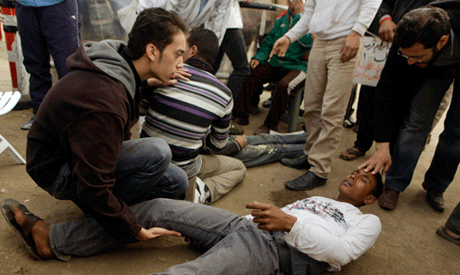
Egypt’s ruling military junta, the Supreme Council of the Armed Forces, launched a deadly attack on thousands of protesters encamped in Tahrir Square on Saturday morning. Security forces killed six protesters*, while the Egyptian health ministry reported that 71 people had been hospitalized.

The attack followed a huge demonstration that took place in Tahrir Square on Friday night. The crowd was estimated at several hundred thousand, reportedly the largest protest since the fall of Hosni Mubarak on February 11.

The huge crowd in Tahrir Square, the epicenter of the mass protests that helped bring down Mubarak, demanded that the military regime rapidly hand over power to an elected civilian authority.

Many chanted that the military junta was identical to the old Mubarak regime. “Tantawi is Mubarak and Mubarak is Tantawi,” the crowd called out, in reference to the top Egyptian armed forces officer, Field Marshal Hussein Tantawi.

Tantawi has led the country since the ouster of Mubarak. He is widely despised in Egypt, having been one of Mubarak’s key henchmen for decades. Protesters also called for the prosecution of Mubarak, his sons Gamal and Alaa, and other officials accused of torture and corruption.

At around 3am local time on Saturday, soldiers and police attacked the Tahrir Square sit-in using tear gas grenades, baton charges, taser guns and live ammunition. Facing down the security forces, large numbers of protesters held their ground, forcing the army to withdraw.

Following the attack, the military issued a statement blaming “outlaws” for rioting, while denying that anyone had been killed or injured by the army or police.

Having failed to crush the demonstration, the army threatened to clear the square on Saturday night. “Tahrir Square will be emptied of protesters with firmness and force to ensure life goes back to normal,” Major General Adel Emarah, a member of the Supreme Council, told a news conference on Saturday.

However, protesters defied the military regime’s 2am to 5am curfew by maintaining a constant overnight presence in Tahrir Square. Those camping out took defensive measures to protect themselves from the armed forces and police, barricading the square with barbed wire.

“We will continue the sit-in until our demands are met,” protester Ahmed el-Moqdami, 25, told Reuters on Saturday. “First of all, the field marshal must go. Mubarak must be put on trial and a civilian council must be formed for the transition period.”

On Sunday, over a thousand people rallied in Tahrir Square to continue voicing their demands. Demonstrators cried “Revolution, revolution,” and burned an effigy of Tantawi. Placards read, “What we want is a civilian council,” and “The people demand the field marshal be toppled.”

Reuters reported that twelve armored personnel carriers full of troops waited near the square, but the armed forces and police kept out of sight.

The Egyptian military were able to achieve some popular backing in the run-up to Mubarak’s ouster and in the period immediately afterwards, largely thanks to the uncritical support given to the generals by bourgeois opposition figures such as Mohammed El-Baradei and the Muslim Brotherhood party. But the anti-democratic character of the military junta has been exposed to the masses more clearly in recent weeks.

Faced with ongoing strikes for improved wages and job security, and protests calling for social and democratic reforms, the military rulers have turned to increasingly repressive measures. On March 23, the military banned all strikes and protests and imposed severe punishments for those taking part in any public expression of opposition to the regime.

Reacting to the ongoing mass opposition to the regime, the Muslim Brotherhood announced on Thursday that it backed street protests calling for the prosecution of Mubarak and some government officials. The Brotherhood has refused to take part in protests for weeks, and is still working behind the scenes with Egypt’s military rulers.

Abdullah Helmy, a leader of the Revolutionary Youth Union, one of the groups formed around the anti-Mubarak protests, told the Wall Street Journal that the Muslim Brotherhood was “afraid of losing momentum” and were rejoining the demonstrations only in order to bolster their chances in parliamentary elections proposed for September this year.

The crackdown on Friday night allowed the junta to test the water for future repression. For now, the regime has backed off from a major confrontation with the working class, and has reportedly offered the minor concession of dismissing some unpopular regional governors who had been appointed by Mubarak.

But the military is opposed to any genuine expression of the demands of the Egyptian working class and rural poor. The military high command was an integral part of Mubarak’s regime, and many senior officers have become very wealthy from the privatization of swathes of Egypt’s economy.

Any trial of Mubarak would be a political embarrassment to the current regime, the Egyptian capitalist class in general, and the Western governments and companies that had long and lucrative relations with Mubarak.

On Sunday, Mubarak made his first televised statement since leaving office, opposing any investigation into his crimes and those of his family. Speaking from his luxury compound in the Red Sea resort of Sharm el-Sheikh, Mubarak told the Al-Arabiya satellite network that the rumors of his looting the economy were “unjust campaigns and untrue allegations.”

“They aim to tarnish my reputation and discredit my integrity,” the ex-president stated. He added that he reserved his “legal rights towards whoever tried to ruin my and my family’s reputation.”

Mubarak, his wife and their two sons continue to live in great comfort under the protection of the military. However, fearing a mass popular backlash, Egypt’s chief prosecutor has banned them from leaving the country, and their assets have been frozen. Some reports suggest that the Mubarak family’s fortune may be between $40 billion and $70 billion.

The Egyptian junta has the complete backing of the United States government, continuing the close relationship that Washington cultivated with the Egyptian military under Mubarak.

US imperialism has relied on the Egyptian military for decades as a vital ally in policing the region. Not only did the armed forces provide the backbone of the Mubarak government, helping to oversee the reorganization of the Egyptian economy in the interests of the transnational corporations, but it has also played a key role in assisting Washington’s closest ally, Israel, in the oppression of the Palestinians in Gaza.

Backing Mubarak until the very last, the Obama administration only abandoned the dictator when it became clear that the Egyptian uprising threatened the entire Egyptian bourgeoisie and the interests of imperialism. Washington then shifted gears to ensure that the fall of its long-time ally did not disrupt these US interests.
Washington threw its weight behind the military government as a bulwark against the mass protests and strikes, and recent visits to Cairo by US Secretary of State Hillary Clinton and Defense Secretary Robert Gates have been aimed at getting back to business as usual.

Of crucial importance to Washington is the assurance given by the generals that Egypt will abide by its agreements to cooperate with the Israel Defense Forces and the Pentagon. Showing its subordination to the predatory interests of the imperialist powers in North Africa, the Egyptian military has been acting as a cat’s paw for the US in the Libyan conflict, supplying weapons to the CIA-backed “rebel” leadership in Benghazi.

Looking to continue the IMF-backed structural adjustment policies that have turned Egypt into a cheap labor haven for big business, the Obama administration has also been working with its allies in Cairo to develop a US-Egypt Enterprise Fund. The aim of this new body is to “stimulate private sector investment, support competitive markets, and provide business with access to low-cost capital,” according to the US State Department web site.

* (Please note that there are different figures emerging as to actual casualties. I've been informed this is due to mixed reports on the condition of those who were hospitalized when critically wounded. In this report, the author mentions six, earlier reports mentioned two. AB)

April 9, 2011

Egypt Update #39- The Junta's Repression Intensifies, 2 Dead in Tahrir Square

As I said, I would not stop producing the updates as necessary. Last night's tragic events show how far the struggle for freedom in Egypt has been setback by the military junta's tight grip on power.

The news piece I include is from the Sydney Morning Herald: Click here

Below is a brief analysis piece submitted here as a comment by compañero Mahdi to my prior update.I felt it critical enough to be released here in this separate update. AB


By M.A. Al Mahdi
APIC(APICONG)

Tonight's events at Tahrir Square are a very strong illustration of Adrian's analysis on Update #38.

Throughout the night Armed Forces, police and security combined in an assault on popular resistance, which has left 2 dead and over 15 injured.

Palestinian flags had been replacing the Egyptian ones in solidarity with Palestine, as the brutal assault on Gaza unfolded, simultaneously with the escalation of army violence in Cairo.

Although the protests were dispersed with the utmost brutality, the protesters gathered again and returned to Tahrir, calling for the ouster of Tantawi. Most significantly, this night has seen the first attempts at armed resistance.

Circa 2000 people are gathered at Tahrir at this moment. Violent scenes are still taking place.
The people, however, are shouting: WE WON'T LEAVE!

APIC (APICONG) is calling on the workers and peasants of Egypt, on the Trade Unions and on Egypt's Communist Party to unite in a nationwide general strike to oust not Tantawi but the regime itself and its cornerstones; neo-liberal economy and the New Order.

We are calling upon the revolutionary people of Egypt to rise to a full-scale revolution, eliminating oppression, mental and economic slavery, neo-colonial dependence and the exploitation of man by man.

We are calling every man, every woman and every child in Egypt to organise themselves as a bulwark against reaction and counterrevolution, and as an army of the revolutionary people's struggle for liberation and socialist rebirth.

This is the moment when political leadership crystallises itself, and when friend and enemy become manifest.

There are those who seek to halt the developments that have become inevitable. There are those that seek to create division and disorientation among the people. And there is Al Baradei, who, in the face of the present onslaught proclaims: "Continued trust between army and people vital to national unity. Dialogue is the only option."

A dialogue between sheep and butcher. A dialogue between the whip and the back it ploughs with scars.

Here too we see the Egyptian uprising in all its strength. Here too we see the Egyptian uprising in all its weakness.

In this crisis too there is a cohesion born of an iron determination, and yet, there is, even today, the confusion and ideological insecurities of old.

There must now emerge, as in every crisis everywhere, a leading power that carries the line, capable of meticulously planned revolutionary action. For the enemy is strong, ruthless and determined. For the actions taken now will result in the crushing or the victory of the people's cause.

For Egypt, socialist and free!

M.A. Al Mahdi
APIC(APICONG)

April 5, 2011

Egypt Critical News Update # 38- Phase One Wrap-Up

Adrián Boutureira
April 5, 2011


Dear Friends and Comrades,

For the last two months I have tried to do my part to support the legitimate struggle for justice and freedom waged by the Egyptian people against their oppressors.

By shifting the use of this personal blog to writing and reproducing critical news and analysis about the Egyptian uprising since its onset, I hoped to humbly serve both, the struggle there, as well as those here in solidarity with that struggle. After all, information is power, or so they say (I think power is power and the rest academic bullshit, but that's a different story.)

I am not discontinuing the reports,  but I do not see the present situation in Egypt warranting the use of this space exclusively for Egypt related postings right now as it has been over the last two months.

I believe a phase in the struggle has ended and we are now in a period of preparations for phase two...In the meantime, I need to get back to using this space for what I had originally intended it for, i.e. the shameless peddling of my quasi-literary efforts over the years. There are still several folders of yellowing scribblings left I need to subject you to, but rest assure that as the struggle in Egypt continues, so will my solidarity work here  providing you with critical news and analysis from a revolutionary perspective.  

End of Phase One of the Egyptian Uprising- Brief Analysis

The machine set in motion to impose the farce of cosmetic and mainly symbolic political reforms under the military junta's control have, for the time being, appeased a vast majority of the Egyptian population and serve to marginalize the remaining defiant voices of true resistance. I believe that much is irrefutable.

It didn't take very long for key sectors of the popular uprising to call it quits after Mubarak's symbolic removal and to accept the subsequent inconsequential concessions granted by the new/old military rulers, thus legitimizing their usurpation of power. The mass demobilization caused by this shameful capitulation, which some called a victory, not only lost the uprising control of the streets, but also allowed for the isolation and brutal persecution of those pockets of resistance which had begun (and still continue) to construct a more anti-imperialist, anti-capitalist vision of the struggle, and to take the fight to the next level.

The initially tacit betrayal by key moderate sectors of the movement against the struggle and demands of those seeking a much deeper and immediate shift in Egypt's power paradigm, soon degenerated into active public condemnation and opposition. This not only served to split the movement and the Egyptian people further, but it also served  the military junta's own intentions to isolate, discredit and criminalize any ongoing organized resistance to their charade. The moderate forces quick compromise with the junta's illicit authority, coupled with their embracing of the regime's narrative that the present process is indeed the most effective and stable long-term conduit for delivery of the people's demands, was a death blow to the uprising's promise of real and immediate radical changes.

I find this pathetic capitulation to be more of a commentary on the inherent weaknesses of the still much celebrated and hyped "spontaneous", "facebook generation", "non-ideology driven" popular uprising, than about anything to do with the true capacity of resistance of the Egyptian working class. This uprising lacked real comprehensive and unifying revolutionary foundations and vision from the beginning. It was thus politically doomed and unsustainable as an agent of immediate and cohesive revolutionary change from the get-go.  In my opinion, still useful as a historic stepping stone onto a new and more sophisticated long term phase of resistance, but it never was a revolution in the traditional political sense of The Word.There has been no such revolution in Egypt yet.

Is there in existence a significant force of revolutionary leftists in Egypt that are organized, united and committed to the necessary radical shift in that country's economic and political policies?  I wish I could answer this with an honest and unequivocal yes, but I can't really do that. All that my study and evaluation of the present conditions enable me to say with any certainty, is that authentic leftist tendencies were indeed there during the uprising and are now apparently continuing to coalesce and self-organize. I say apparently, because unlike other uprisings of similar magnitude in recent years with which I have worked in solidarity, like in the case of the Zapatistas in Mexico, the Egyptian radical left is at a totally different stage of development. It continues to emerge through this period of resistance in a very piece meal fashion, attempting to make a quick transition for a modus operandi developed for underground activities during decades of persecution and clandestine status to that of open mass organizing movement building conduits. Presently, these forces are  lacking the logistical means in the course of decades of repression to be able to say much to the outside world and/or engage in international solidarity efforts, therefore public information about their victories or organizing initiatives is incredibly difficult to obtain.

When trying to understand the role, or lack thereof, of the revolutionary left in the recent struggles, again it must be made clear that after 30 years of brutal persecution and oppression the revolutionary left was not, on January 25th 2011, in an organizational position to assume a leadership role. Without the revolutionary left's traditional organizational capacity and ability to organize and mobilize the masses and offer them a critical  anti-capitalist analysis to energize them, the mass movement building task was left in the hands of a group of mainly politically naive and disorganized middle class youth who quickly sank into disarray the moment clear ideology and analysis was needed to pick up where spontaneous mass insurrection leaves off....

I believe this became a significant factor in the compromising direction that the uprising took and the poor staying power that it showed to see the fight through. A list of  reform demands are not a substitute for a unifying revolutionary ideology with a clear social, political and economic analysis and agenda.

It is clear that the type of struggle waged and leadership shown in this recent uprising did not have the capacity to pull off a total overthrow of the regime and/or take on US-Zionist power agents in Egypt head on. It did manage to ignite an awakening of the Egyptian people's sense of capacity and potential to challenge power though, and it is in the development of this awakening that I believe Egypt's future lies over the next few years.

The present political and economic system, even with electoral politics in full circus swing and more mass-appeasing reforms getting instituted, will remain incapable of truly addressing the key challenges facing the Egyptian people, particularly those of its working and peasant classes. The reforms, specially those aimed at broadening political participation, will, as planned, open up the political playing field to previously excluded sectors of the bourgeois intelligentsia, but these will go on to represent their own class interests, not lock horns with neoliberalism or US Imperialism in any significant fashion on behalf of the oppressed.

In my opinion, it will then become a question of how effective will the true revolutionary political tendencies in Egypt be in gaining ground over the next few years among the Egyptian masses. Will there be a class struggle informed mass movement born out of the lessons of the January 25 uprising? Will these forces manage to coalesce into a significant political force capable of leading the masses and challenging the entrenched plutocracy as well as the emerging moderate and revisionist political forces that keep attempting to co-opt their struggle?

I don't think anyone can, at this conjuncture of history answer these questions with any certainty. Even those workers risking their lives and still organizing in the streets of Alexandria, might not know how the full onslaught of constantly shifting global and national conditions will affect their writing of Egyptian revolutionary history over the next few years. The science of revolutionary change, as all others, remains a developing discipline.

All we know for sure is that the struggle for justice will go on as it has throughout history. Now more than ever, this struggle will have to be focused on the collapse of an economic system and global order which has brought us to the brink of ecological collapse and is condemning the majority of the world's population to live in dire and desperate conditions while the few benefit from the destruction, exploitation and marginalization. The radical shift is no longer a mere struggle between political orientations, but a question of the struggle against self-destruction and for the survival for the whole of humanity. For this reason alone, the Egyptian people can not go back but only forward. La lucha sigue hasta la victoria...

March 24, 2011

Egypt Critical News Update #37- Military Rule and Repression,The Tahrir Diaries

Since the military coup in Egypt, large numbers of political activists have been arrested, beaten, tortured and imprisoned. Many of them are now facing charges in military tribunals.

These acts have not surprised many of us. We saw it coming and warned against it long before the army had even consolidated their rule. After all, this is Mubarak's regime army which, as I reported here on update #6, as early as on February 1 was in direct contact with the US Defense Secretary easing US fears about the safety of US interests in the region, and pledging good and ongoing Egypt-US military cooperation...From here forward, we knew the coup was inevitable and only a matter of time (see update #13)

This Army was never a friend of the people or of the revolution. For 30 years it served as a faithful tool of Empire and of the regime's oligarchy, and the fact that so many so-called activists in Egypt thought it could ever be otherwise, is regretful. This naive expectation has inflicted a severe blow upon the true revolutionary intentions of many in the Egyptian front-lines. The now countless counter-revolutionary and reactionary actions taken by the military since taking power have generated a critical setback in the revolutionary struggle for real regime change, i.e., an immediate radical shift in the power paradigm of Egyptian society, which would lead to the real and positive social, political and economic transformation of the country.


Against military trials of civilians
 Nevertheless, a group of committed activists who strongly condemn the violations the army commits towards civilians under the pretense of ” protecting the country from thugs” have organized a campaign to keep records of the abuses as well as for demanding an end to all military trials of civilians, and granting those who had been charged/sentenced a fair re trial in front of their natural civilian court.


Following is the link to their site. Available material and information in English is there, but somewhat limited.  I encourage everyone to take a look and help support the effort if and how they can.Translations in particular are needed.


DIARIES UNDER MILITARY RULE


Free Amr Eissa

March 22, 2011

Egypt Critical News Update-#36 Communist Party of Egypt -Press Release


From The Egyptian Communist Party’s Website:
March 14, 2011


The Egyptian Communist Party held a comprehensive meeting that included all its different entities and subcategories. The meeting resulted in a unanimous decision to officially announce the party’s existence and activities, considering the new and healthy political and social environment that has resulted from the January 25 revolution, and after years of being forced to work in utter secrecy and under much repression.

The party has agreed to continue the communist journey that began in the 1920s, despite the fact that the communist concept has been reproached and widely misused by corrupt anti-proletariat regimes over the past decades.

The Egyptian Communist Party was re-inaugurated in 1975 and is legitimated by the masses – and this is authentic legitimacy. This goes back to its long struggle and strong connection with the working class in Egypt, as well as the social and political aspirations of hardworking Egyptians. It is these same people who – today – aspire for a society built on freedom, justice and honor, alongside freedom from dependency, tyranny and oppression.

Even though the Egyptian Communist Party was forced to work in complete secrecy for many years, its partaking in democratic and frontal achievements since 1975 are simply undeniable. Members and calibers of the party come from all walks of life and have made positive and powerful contributions to the events of our revolution. For more than 9 decades, Egyptian communists have made unprecedented and strong contributions in many fields of culture and community, including literature, politics and unionism.

The communist ideology has survived campaign after campaign of aggression by regimes backed up by right-wing extremists across the Arab world supported by imperialist forces, only by working in utter secrecy, with much persistence and through the ample support of the masses.

The Egyptian Communist Party confirmed that it will be holding its 4th general conference in the near future to determine the ideal plan of action and organizational chart that will guarantee the demands and aims of our revolution during the coming period.

Egypt Critical News Update-#35 Understanding the referendum's "yes" vote

Cairo, where the No vote was highest

The Vote's Figures:

Out of about 45 million Egyptians eligible to vote, 18,366,764, or 41.19 percent, hit the poll stations on Saturday.

According to the Supreme Judicial Committee supervising the referendum, 14,192,577 voted yes (77.2 percent), while 4,174,187 voted no (22.8); 170,190 ballots were invalidated.

Cairo had the highest turnout with 2,306,561 voters, 59.9 percent of whom said yes, the lowest among governorates.

Alexandria came second with 1.5 million voters, 66.6 percent of whom said yes.

Urban areas around Cairo had more support for the amendments with 67.2 percent of Giza’s voters saying yes, 71.4 percent of Helwan’s and 83.5 percent of Sixth October City.

Delta governorates of Sharqya, Beheira, Daqahlya had the most sweeping support for the constitutional amendments scoring 85.9, 86.9 and 79.1 percent, respectively.

Minya had the highest turnout among Upper Egypt governorates with 1,121,260 voters, 75.6 percent of whom said yes.

Southern Sinai governorate had the lowest turnout with 39,128 voters, 66.1 percent of whom supported the amendments.

Assiut governorate which has a large Coptic population, reportedly against the amendments, had 72.5 percent of its voters choosing yes.

No governorate had a majority refusing the constitutional amendments.

--------------------------


Analysts fear the YES vote means upcoming elections will be dominated by the Muslim Brotherhood and the Regime's party, the NDP


  By   Heba Fahmy / Daily News Egypt March 21, 2011, 1:04 am


CAIRO: The majority of Egyptians voted “yes” to the constitutional amendments, paving the way for parliamentary and presidential elections, the first of which are to be held in six months.

Analyst Nabil Abdel Fattah, a researcher at Al-Ahram Center for Political and Strategic Studies speculates that the Muslim Brotherhood and the remnants of the National Democratic Party will dominate parliamentary elections as a result of this “yes” vote.

Abdel Fattah told Daily News Egypt that he believed the NDP made a deal with the Brotherhood in order to exploit the group’s numbers, financial resources and public influence to hasten the parliamentary elections in order to dominate them.

“The NDP is a party based on personal interests and they were forced to cooperate with the Brotherhood to preserve these interests,” Abdel Fattah said.

Abdel Fattah added that the NDP and the army want to preserve Israel’s and the United States’ interests in the region and ensure stability.

“The United States and Israel want only limited reforms in the country while maintaining the country’s foreign policy to preserve their interests.”

Hossam Tammam, a researcher of Islamist movements agreed with Abdel Fattah saying, “The Brotherhood succeeded in mobilizing large numbers of people to vote yes to serve the Brotherhood’s best interest in the name of religion and stability.”

“There are many indications that there are in fact agreements between the Brotherhood and those who want to restore the former regime and work against the revolution,” Tammam told DNE.

The referendum isolated the Brotherhood from the rest of the opposition powers and portrayed the Brotherhood as an ally to the former regime which is against democracy, he added.

“This reduced their popularity in the political arena and is likely to negatively affect them in the parliamentary elections.”

Emad Gad, researcher at the Al Ahram Center for Political, agreed, saying, “I don’t believe in this big fear that the Brotherhood will dominate the polls if the parliamentary elections are held in June.”

“Of course it would be better to have parliamentary elections in September,” Gad said. “However, even if they’re held sooner, the political parties are capable of organizing themselves and preventing [the Brotherhood’s dominance] from materializing.”

The army had announced that parliamentary elections are to be held in June and are to be followed by presidential elections six weeks later, in case the people approve of the constitutional amendments. Leading Muslim Brotherhood member Essam Al-Erian said last week that the army agreed to hold the parliamentary elections in September.

Gad said delaying the elections would give political parties a chance to organize and prepare themselves better.

The ruling Supreme Council of the Armed Forces suspended the constitution on Feb. 13 after a popular revolution ousted president Hosni Mubarak two days earlier following almost 30 years in power.

An appointed panel of legal experts drafted the proposed amendments in 10 days, as the military council strove to restore civilian rule as quickly as possible and keep the army above the political fray.

The amendments ease restrictions on independent presidential candidates, stipulating that candidates are eligible to run if they collect 30,000 signatures from at least 15 governorates in Egypt, with a minimum of 1,000 supporters in each, if they are endorsed by 30 members of parliament, or if their party has at least one seat in parliament.

A president can only rule for a maximum of two four-year terms, according to the amendments.

The amendment to Article 75 set conditions for presidential candidates that include a minimum age of 40, stipulating that the nominees and their parents and spouses be Egyptian.

The amendments also put the responsibility of drafting a new constitution on the shoulders of the new president and elected parliament.

The elected parliament is to appoint a constituent assembly to draft a new constitution within six months of its appointment. The new constitution would be approved by a referendum within 15 days of its completion without any interference from the upcoming president.

However, the proposed amendments triggered wide debate among constitutional experts on whether the wording of article 189 make it obligatory for the PA and the president to initiate a complete overhaul of the constitution.

March 14, 2011

Egypt Critical News Update-#34 Business as Usual...and then some.

Egypt's Workers. The only hope for a real revolution...

The following news article could be almost surrealistically funny all the way from beginning to end,  if what it reveals wasn't also so pathetic and treasonous to the costly struggle being waged in Egypt by the working class for real justice and democracy in government.

The two or three paragraphs about the discussions held between Egypt's business associations and the new prime minister and ministries of Manpower, Trade and Industry and Finance and Planning, pertaining to labor in particular, really show where this new regime really stands.

The business establishment has not only received assurances that as a class their interests remain the highest priorities of the regime, but also that even any minimum wage increases considerations will not take place without their input. Even though independent unions can now be formed (which the prime minister as an ex oppressed engineer feels is a great thing), the regime is still going to force the envelope against strikes recognizing they affect Egypt's international business climate negatively and hinder national productivity.

To make matters worse, on the political front, Albaradei, a devout neoliberal,  has now decided to rebrand himself as a socialist democrat...With the true  left in shambles and the upper middle class children who feel own this movement still as confused as always about their class allegiances, many in Egypt's liberal intelligentsia community are considering supporting the presidential candidacy of this puppet who, in his tenure as Director General of the International Atomic Energy Agency was complicit in his silence with the deceptive justifications fabricated by the US for the Iraq invasion.

Egypt's FB revolutionaries have nothing left to offer. The only hope left are the emerging forces trying to form a legitimate worker/peasants socialist movement. The rest is a bourgeois fantasy.

The historical class enemies of the workers have yet again emerged, now in Egypt, as self-proclaimed leaders of a quickly fading and betrayed revolution that was never theirs in the first place. It is now up to the Egyptian working class and peasantry to self organize and lead Egypt in earnest into a real revolution, OUTSIDE of tweeter wetdreams this time...It is that or nothing. Socialism or capitulation...


Egypt to continue free market economy rule, ensure social justice


By   Amr Ramadan / Daily News Egypt
March 14, 2011, 10:54 pm


Essam Sharaf


CAIRO: Prime Minister Essam Sharaf said Sunday Egypt will continue to be a free market economy, but that this will be accompanied by policies that achieve social justice and welfare.

After the Egyptian government announced wage reform plans and allowed independent workers’ unions to form in light of an all out assault on businessmen by the media, many feel uncertain about the economic direction the country is headed in the wake of the revolution.

However, these fears may be quelled by Sharaf’s announcement.

Sharaf met with delegations of businessmen from the Egyptian Businessmen Association (EBA) and the Egyptian Junior Businessmen Association (EJBA) to discuss how the revolution has changed the economic future of the country and ways to overcome the obstacles posed by political uncertainty, increased bureaucracy and rampant corruption that impede investment and economic wellbeing.

The meeting was also attended by the Ministers of Manpower, Trade and Industry, Finance and Planning.
Hussein Sabbour, chairman of the EBA, told Daily News Egypt he was optimistic after the meeting and that the ministers had agreed to most of their requests.

“I really felt that the Prime Minister and the ministers present understood our concerns and were ready to take action,” he said.

Amer Elwy, executive director of EJBA, which according to him has 650 members with 350,000 employees, was also optimistic.

“Since the meeting we have been extremely optimistic and we have seen actions taken in the last 24 hours, the optimism comes from the positive response from the government and their ministries, which are very hands on and proactive,” he said.

Sharaf assured the businessmen that the sense of security in the country, which they had called for, can be achieved quickly through the efforts of the armed forces and the police, but it will be achieved in the long term by ensuring social justice.

According to Sabbour and Elwy, security was the top priority for both delegations whose demands were mostly similar.

Sharaf also agreed with them that the fight against corruption should start immediately but should not tarnish the image of the businessmen which was another major concern for both delegations.

“If we open any newspaper, we find half of the articles about corruption of businessmen,” Sabbour said.
“That can’t be all our focus. There are corrupt businessmen, and there are businessmen who have added value to the community by creating jobs and attracting investments. These cannot be dealt with equally as most of the media is doing now,” he added.

According to Elwy, the EJBA suggested that the government coordinate community awareness campaigns about the importance of the role of the businesses in the community and the rights and duties of the stakeholders in terms of workers and employers.

EJBA also asked for the protection of businessmen whose names are being mentioned in the papers, until they are proven guilty.

The ongoing workers’ protests were also another main concern for both parties. The Minister of Labor was asked to suspend negotiations with workers who are leading to a halt in production.

While both Sabbour and Elwy said the workers had the right to protest, they claimed that this was detrimental to the economy and so called on the protests to stop.

However, Sabbour said that the government’s decision Sunday to allow the formation of independent workers’ unions and syndicates and offering them capacity building and training was a positive step for businesses as it would facilitate the negotiation process, eventually leading to a resumption of production.
“Freedom to form unions and create syndicates should be above all else, and I am personally happy about this because I did not like the State Security involvement in the Engineers’ Syndicate which I am a part of,” he said.

A large part of the meeting was dedicated to address the deteriorating business climate in Egypt.

“We suggested that the government take into account a very useful study about the business climate in Egypt and the necessary solutions which was prepared by the EBA and presented to the previous government and was clearly put on the shelf, but Prime Minister Sharaf was prepared to look into it,” Sabbour said.

The EJBA gave detailed suggestions on facilitating issues regarding small and medium businesses which they represent.

It suggested financing for small and medium-sized exporters, tax incentives for projects that start or plan to expand in 2011, facilitating the granting of licenses for operation of factories, continuing export subsidies and private sector involvement and consultation in any government decision which affects the private sector, such as minimum wage and succession in addition to many other policies and strategies.

According to Elwy, these were all taken into account by the relevant ministries.

“We already had a meeting with the Minister of Manpower and plan to meet with the Minister of Trade and Industry soon. This would have never happened with this speed before,” he added.


March 13, 2011

Egypt Critical News Update-#33 Egypt in March-Analysis of a Bloody Week

Army and Security Forces in Position Throughout Cairo

Egypt in March - Analysis of a bloody week 

Muhammad A. Al Mahdi
APIC(APICONG)
March 12, 2011

Against the background of intensified demands for democratic change, the brutality of the military regime has increased to the level of unconcealed repression.

The strategy of the regime has manifested itself in the use of hired thugs to attack peaceful protesters complemented by the provocation of sectarian clashes at street level, and in the restructuring of the State Security Service, the re-deployment of Mubarak's police force and the presentation of Muhammad Al Baradei and Amr Musa as candidates for presidency at state level.

This is a spider's web of reaction carefully spun around the youthful, inexperienced and often dangerously politically naive forces of national rebirth and revolution.

The inacceptability of Musa is so obvious that it does not merit any further elaboration. He was put up as a candidate merely in order to fail. The entire purpose of his candidacy is to serve as a sparring partner to Al Baradei, who is a much more sophisticated pawn in the game.

Al Baradei embodies the type of the dynamic "progressive technocrat" we see exemplified in Barak Hussain Obama, the civilised version of George W. Bush, the master of charades with the aura of change, who may at times appear politically spineless but is strongly power-driven and enormously elastic. Being a ruthless (and willing) instrument to the aspirations of US- and global imperialism, he is yet never without one or two points to his credit. And this is true of both men. They can  indeed be expected to get along with each other extremely well.

This is why Al Baradei, for his part the civilised version of Mubarak, is the ideal choice for the United States political-economic establishment, who have forever tried to make him the "leader of Egypt's opposition".

No one single person has played a more decisive role in the preparation of the ground for the invasion of Iraq than Muhammad Al Baradei, America's nuclear watchdog.

A great many of today's revolutionaries and "revolutionaries" might be too young to have followed and analysed the developments that led to the imperialist aggression against the sovereign Middle Eastern nation of Iraq, at the time one of the major powers in the region and one among a mere handful of states who, for reasons of their own, declined to bow to the whip of Western domination and resist the aspirations of neo-colonial conquest.

Masterfully manipulating internal conflicts and territorial disputes (and let us remember that all borders in the Middle East are artificial), the imperialist powers prepared the destruction of Iraq in two phases, conducting what was a long and protracted campaign of systematically undermining, step by step, the nation's defense, political coherence and economic infrastructure, hence the entire fabric of its sovereignty. In the final phase of this campaign, alleged nuclear weapons were introduced on the scene so as to provide a justification for the eventual invasion. The task of finding these was delegated to the nuclear expert Al Baradei, who sought what did not exist in full knowledge of its non-existence.

He carried out this ridiculous operation over months during which he pursued the systematic demoralisation of Iraq by means of continuous inspections and searches for weapons of mass destruction, which were nothing else but a protracted internationally sanctioned smear campaign. No one knew better than Al Baradei that none of these ever existed and could therefore not be found. The nerve gas used in Halabjah was supplied, which is another open secret, by the imperialist powers themselves, at a time when that same Saddamist Iraq was their strategic ally.

Meanwhile Bush and his European satellites decided that Saddam's weapons of mass destruction were magic devices that could be rendered invisible and the existence of which did therefore no longer require verification. Thus, Al Baradei's efforts were no longer needed and the conscience-plagued socialist democrat was finally free to admit that he had failed to find any evidence for the existence of these. And mark you well, he did not say in his report that these weapons did not exist but merely that he had not been able to find them, nor did he explicitly say he was against the invasion. He merely stated that the evidence he found did not justify it.

This, in itself, was a well-calculated step, for these remarks were made at a time when they had already become entirely irrelevant. After his having prepared the ground for the invasion, they were a mere smoke screen intended to wash his hands of the bloodshed to follow. But blood sticks. It leaves traces. And the wounds of Iraq haven't healed.

Here stands the man responsible for a national catastrophe, and for a crushing defeat of the Middle East's aspirations for political independence, loosened on his native Egypt. And worse than that: here stands the murderer of Iraq, cheered by Egypt's intelligentsia.

This raises the question of the role of the intelligentsia, as a whole, in the process of social revolution. The privileged position of this class, in comparison to the vast deprivation and poverty suffered by the working classes, the rural masses and the tribesmen that make up the country's social identity, renders their needs for change minimal and therefore causes them to be satisfied with minimal changes. Their isolated, as it were, root-less, position as a class, as well as their Westernisation, do not promote firmness of position nor political clarity.

And in this lie the limits of the idealist intellectual leaders of the Revolutionary Youth Coalition. This is what made them cheer Shafiq's military government after the ouster of Mubarak. This is what rendered them entirely unprepared for the violence which this "honourable neutral army" was to unleash upon them at the moment they were out of the spotlights. This is what makes them cheer for the imperialist chain dog Al Baradei now. This is what renders their political steps so groping, tipsy, uncoordinated- and increasingly inefficient.

It is to be feared that a few idealists coming straight out of the lecture halls are no match for a political empire built on cynical calculation. Even though this empire is shaken by a monstrous economic crisis  as well as by a series of revolutions against the neo-liberal system on which it relies (which came only partially as a surprise and which it is increasingly apt to contain), it has not lost its agility, nor its resourcefulness.

And let us be clear that neo-liberalism is merely one facet of an economic system the political expressions of which range from "social market economy", it mildest from, to fascism, which is its ultimate reaction to mortal inner crises (which is why we are seeing a rise of -increasingly "respectable"- fascist tendencies in Europe, the US and Zionist Israel).

We must not be deceived. The enemy is strong. The enemy is ruthless. The enemy is ready for everything.The question is: where do we stand? What do we have to offer? How do we, nationally and internationally, consolidate our ranks in order to stand our ground?

We have seen 2 million at Tahrir, at the best of times. What is that more than a drop of water in an ocean within the vastness of Egypt, the most-densely populated country in the Arab world? There is indeed an ocean of people who are still silent, who cannot be reached by social media, who are a world apart from Egypt's intellectual elite.

The question is: how do we get them to speak? And most of all: when and how shall they rise to liberate themselves by their own action, to take their fate into their own hands and make this revolution their own?

The use of social media as well as the absence of a leadership structure has been a strength of the revolution in its initial stage because it rendered it resistant to the suppression and infiltration techniques of the Mubarak regime. But with the initial stages of the revolution behind us, they have become a liability. They have become the haven of an increasingly disoriented exclusivist elite and a hindrance to the revolution's gaining new momentum and new ground.

What is needed now is an organised apparatus to disseminate information, analysis and revolutionary propaganda in the form of a news service created by the revolution for the revolution, providing reliable, structured information in written form as well as oral transmission.The revolution, at this stage, must shed its urban image.The revolution, at this stage, requires an organised and disciplined party of the masses that is effective nationwide and cross-border.

It is for the Coalition of Revolutionary Youth to support, by all means at their disposal, the formation of such a party or movement, to affiliate with it and, in the face of the candidacy of Mousa and Al Baradei, put forward a presidential candidate of its own.

Forward, workers and peasants of Egypt! Forward, women of Egypt! Forward, revolutionary youth! Forward to the consolidation of the revolution by all means necessary! Forward to the organised defense of the peoples' revolutionary achievements!

Muhammad A. Al Mahdi
APIC(APICONG), March 12, 2011

March 9, 2011

Egypt Critical News Update-#32 Brutal Surprise Attack on Square Demonstrators

Brutal surprise attack on demonstrators at Tahrir square by thugs and the army. Many arrests and injuries being reported.

Many of us saw this coming. The responsibility of this is indeed on the shoulders of the ruling junta, but also on those of the reformists and revisionists who have betrayed the revolution by accepting the rule of the military coup, and by abandoning their comrades still struggling on the streets against that fascist infamy. I am saying this to you in no uncertain terms: You have betrayed them and the revolution. Your collaboration with the military and lack of ideological clarity have fueled and provided cover for this attack and for all the attacks that we know have never stopped since the military took power against the true revolutionary voices inside Egypt.

NOTE:

Dear Egyptian Comrades:

We presently have no cohesive way of attaining timely news analysis from Egypt in English from the revolutionary forces still struggling there. This is a major handicap for those of us working in solidarity from outside. We need to work this out organizationally. It has become a real problem to rely on single activists that are being arrested or attacked and then need to lie low for a while or are being disappeared.

99% of all news about the situation is coming out of fairly reactionary mainstream sources. We are struggling to decipher and navigate through those. That is way too unreliable and not desirable for the role of internationalist solidarity workers. In addition, those main media services can pull the plug whenver they want or shift the framing at will to suit their own interests. We NEED a regular revolutionary news analysis source coming out of Egypt daily in order to continue to be effective in our solidarity information disseminating work. 

Speaking of. This is where we had to go to get the news story for the assault. Note how they cover the initial military presence at the square. We know that what the army has intended to do, time and time again when they come in firing in the air, is to scare the demonstrators and their supporters away. They did this before and the harden revolutionaries know this and stay put, thus the follow up violence.

This type of reporting almost makes it seem as if somehow there were two separate conflicting army orders being executed...There were not! They were there to evacuate the square and beat the shit of those who resisted. Also, giving credence to the notion that these were not state supported thugs, but angry local businessman is ludicrous. The businesses around the square have done exceptionally well over the last few weeks and the occupation was not interrupting traffic. I also doubt they would've spontaneously self-organize in their hundreds into a fire thrower and machete wielding mob! overall not a bad article, but we can't keep coming here for these type of critical news.

From Ahram online:


Tahrir Square.

The Egyptian Army started evacuating Tahrir Square of protesters following days of sit-ins. "Without any notice the army started attacking us, distorting our camp and forcing us to leave the place," says Rasha Azab, one of the protesters.

Earlier this noon hundreds of thugs approached the square, chanting "The people demand the evacuation of the square," and started throwing stones at the protesters who responded with stones in defence

"In the first attack, the army interfered at a late stage to separate the two groups after the situation became very serious," says Ismail Abdel Fattah. "They used tear gas and fired bullets to the air to keep the thugs away," he added. "But later thugs and the army attacked us."

For the past few days the army has been calling on protesters to evacuate the square, but the protesters insisted on staying until all the demands of the 25 January Egyptian Revolution are fulfilled. Today the army forced the situation.

Those described by protesters as "thugs" claim otherwise. Many of them say they are workers in shops downtown and other places who think that the sit-in was affecting their business. At least 25 were wounded and at least two armored vehicles were seen moving towards the square to restore calm.

Tens of protestors have been arrested on both sides through the day, but it is still to be seen if the army will press charges against them.

Video

Not very good quality, but you can get a sense of what went down. Watch the army on the first video form a protecting cordon between the people on the streets and the thugs attacking the camp. The cordon is not stopping the attack but clearly preventing people from intervening.

Street level video

http://www.youtube.com/watch?feature=player_embedded&v=eQCP2oUcPg8#at=18


March 8, 2011

Egypt Critical News Update-#31 Torture Chambers Found-Military Brutality Testimony

Following are two reports from two separate direct actions taken by Egytian civilians recently. 
The first, is a testimony of the treatment received by the military by one of the demonstrators that was arrested after they had organized a sit-in in front of the ministerial cabinet in Cairo in the evening of the 25th of February and into the morning of the 26th.

The second, reports on the results of the storming of the security offices in Alexandria and Cairo on Saturday, March 5.


Personal Testimony of Military Brutality on Demonstrators

(Unedited)

This is a translation of the testimony written by Muhammad Mosa originally published here 

The person in this picture - that is myself – is the same person in this video, at 1:25 minutes. http://www.youtube.com/watch?v=h5GSfSRY2PQ

Due thanks..
I will start with reference to the kind treatment we received from the unit 28 military prosecution, as well as the respect and grace with which we were treated on the morning of the 26th of February when we were transferred to the military police administration. To be honest the Major General running the military police administration, and fellow officers and individuals were all very generous, and treated us like guests and not criminals.
And an extra thanks to the Major General for paying special attention to our cases – those who were beaten and assaulted the dawn of that very day – and taking me and a friend to Kobry El Qubba hospital in the company of an Officer to help with the ex-rays and check-ups and ensure our safety himself.  They sent the rest back to Tahrir in a microbus at the same time.

Right before the Sit-in was dispersed…
We were a little less than 150 people that night. At around 11:30 in the evening of the 25th of February, army soldiers formed a cordon around us without violations; one of my friends thinks this might have been their way of kettling us and making sure our numbers don’t grow around the ministerial cabinet.  They dismantled their human cordon at 15 minutes past midnight of the 26th of February. At around that time we started hearing news of the sit-in in Tahrir being violently dispersed. And at around 1:30 am that very night, the army started using electric batons to disperse the sit-in and of-course we ran. They continued to push, beat and kick at us, until they managed to disperse us.

And then I was arrested…
As I ran, I came across a fallen protestor, and stopped to check on him. An officer grabbed me and started to push and beat at me and I said to him “Don’t hit! Just arrest me!” And he replied “Come here ya ruh ummak”[1] , and they pulled me into a garage in the ministerial cabinet; and this is where the physical and moral torture began.

In the ministerial cabinet’s garage…
I was shocked at the numbers of army personnel beating up protesters in the garage. At first I thought these must have been thugs, but before I had a chance to finish the thought, I was pulled very roughly and ordered to squat on the ground. With that they started to kick at every part of my body; I tried to cover my face to protect it, but one of the officers pulled my arm away and stepped on my face pushing it to the ground, while they tied my hands behind my back. They – Lieutenants, First Lieutenants and a row of officers and soldiers -  then proceeded to kick at my face as if my head were a soccer-ball.
Others around me were much worse off. One was stripped bare in the cold and sprayed with water and beaten, while another was beaten until his shoulder was dislocated, while others were electrocuted with the electric batons. One protester called out to declare he had a heart condition; and they shouted back at him to ask what he was doing in a protest if he had such a condition, as they proceeded to pull his hand away from his heart, and kick him where it was.
Twice we heard what sounded like a high-ranking officer giving an order to end the beating “No one hit any of them anymore!”. But as soon as he would leave, the beating would start again; it was difficult to tell if they really weren’t following orders, or if the whole thing was just theatrical. For the beating never ceased.

What was said in the Garage…
What was worse than the beating and the insults, were the accusations that the officers and military personnel were throwing at us while we were in there. When I first got in they played the old reel of accusations related to treachery and our being spies; I could even hear an officer shout as he beat a protester “And you’re getting 50 Euros to insult president Mubarak ya ruh ummak?!”.  And while we were all hearing variations of this, each of us was specifically asked to say “Long live Hosni Mubarak”, and those who refused got a fresh course of beating.  It was clear to us that they didn’t think they were dealing with thugs, but believed they were dealing with paid security threats.
And one of the personal violations that I could note is their occasional calling out that “We’re in Abu Ghareeb here” , as they piled protestors un-top of each other and beat them.
There was one officer amongst the lot however that was kind to me, and often rough to my perpetrators; all thanks to my mothers’ prayers! He answered my phone when it rang (though never gave any useful information) and ensured that I got all my things back as I was leaving – thankfully I didn’t loose anything.

Who was in the Ministerial Cabinet’s Garage..
We were a little more than ten people beaten and tortured in the garage. There was one person I was sure was a thug, but he was being treated like a spy. And one seemed to be someone who ran away from the army, but he was only insulted. The rest were all, truly protesters (revolutionaries).
There was another group of around (or a little less than) 17 people arrested from the sit-in in Tahrir square; and I can say that 5 of them were really thugs. This group didn’t seem to have been beaten or tortured (not even the thugs) but they had been electrocuted with the electric batons.

Questions that continue to haunt me…
Was what happened truly on account of ‘irresponsible elements’ in the army as it claimed in the official apology? Or was it intended to get a message across? Or are they the infiltrated minority in the army?
Was this on account of orders from higher army ranks? If so, will they be held accountable?
Breaking the curfew shouldn’t warrant any torture of beating; which there is never any justification for anyway… then why did this happen? Does what happened mean there’s some sort of split within the army ranks? That there are some that have stakes in the old regime and want it to survive through Mubarak or someone else? Why is the army so keen on the 6-month transitional period; when there is a call for the development of a presidential council with civilian representatives to lead the state through a year-long transitional period?

----------------------

Torture Chamber Discovered After Storming of State Security Building

After hundreds of protesters barging in Egypt’s state security offices in both Cairo and Alexandria, locked up prisoners were found and freed.

Protesters started hearing calls for help from under the ground when they stormed the state security office in Alexandria. The protestors reportedly released from one of the office’s tunnel cells a prisoner that has been there for 20 years. Yet, this has not so far been confirmed.

It has been said that the death of the young Egyptian activist Khaled Said in Alexandria’s state security branch was a major catalyst in sparking the January 25 revolution that ousted the regime of former President Hosni Mubarak.

In the state security headquarters in eastern Cairo, protestors also heard voices and managed to release 14 women and 25 men from secret cells, said Zakaria Abdul-Aziz, former head of the Judges Club.

“I called the Prosecutor General and asked him to look for the designer of the state security office so we can find others detained in the secret cells,” he said in an interview with an Egyptian satellite channel.

Abdul-Aziz also aims to get the documents that were taken from the Cairo State Security headquarters to hand the classified to the army to allow the military police to take the building over until it is entrusted to the general prosecution.

According to Abdul-Aziz, secret underground cells are not only exclusive to State Security offices, but there are many others at the Ministry of Interior, prison facilities, and Central Security camps.

“We demand that the truth about secret underground cells be known now to everybody.”

The size of one of these cells does not exceed a meter and a half. They are usually pitch dark, very poorly ventilated, extremely damp, and smelly, said a reporter from the Egyptian newspaper al-Youm al-Sabea, one of the five given permission by the army to take a tour in the State Security building in Lazoghli in downtown Cairo.

Like the interior minister’s office at the eastern Cairo headquarters, the offices of State Security officers are luxurious with adjacent bedrooms and fancy bathrooms.

Hell Room

Protestors stormed eastern Cairo headquarters looking for documents and prisoners
The National Democratic Party, which was the ruling party before the military took over, has its Hell Room as well.

This room, former Interior Minister Habib al-Adly said, houses evidence of the violations committed by all senior officials in the country and supported by audio and video.

In the interrogation, Adly said that both Safwat al-Sharif, former speaker of the Consultative Assembly, Egypt’s higher house of parliament, and Gamal Mubarak, Hosni Mubarak’s son, were aware of the existence of this room.

Hell Room brings to mind the Capital of Hell, a book written by political activist Mohamed al-Derini. The title denotes a place in which the activist was detained for 40 days and which he cannot identify since he was blindfolded throughout this whole time.

Derini who speculates that he have been detained at the state security headquarters in eastern Cairo, said that he spent his detention time with bare feet and chained hands.

He added that he was exposed to several forms of torture like laying him down on a wet long chair then connecting his limbs to electricity and sitting him on an electrocuted chair.

By Farrag Ismail

(Translated from the Arabic by Sonia Farid)


March 4, 2011

Egypt Critical News Update-#30 Clashes in Alexandria-Tahrir sit-in challenged-Labor Organizes

Clashes in Alexandria

Live reporting:

There are tweet reports today of serious ongoing confrontations taking place between state armed forces and demonstrators in Alexandria around a building called the State Security building, which seems to have been used for state-sponsored torture. The security forces are firing live bullets.  The building seems to have been set on fire. The army has supposedly intervened...Same action taking place in Dokki and now also Cairo


News from the Square:
Al-Masry Al-Youm Staff
Fri, 04/03/2011
 Protesters started arriving in Tahrir Square Friday morning to participate in another protest that has taken on a celebratory tone following the dismissal of Ahmed Shafiq’s government.  Former Transport Minister Essam Sharaf, one of the candidates nominated by the Coalition of the Youth of the Revolution, was tasked with forming the new government.

The newly-appointed prime minister announced through state-run newspapers and Facebook that he would go to Tahrir Square to talk to the protesters in an attempt to respond to the people and to assert that he stands with the revolution.

The Coalition of the Youth of the Revolution called for today’s protest, entitled “The people want to continue the journey.” Notably, the youth of Tahrir were divided between two camps; some argued that their demands had been met and called for an end to the sit-in after today’s protest. The other camp viewed the removal of Shafiq’s government as a “partial victory” and called for protests until all demands have been met.

The coalition issued a statement reiterating a number of demands, including the need to dissolve the state security apparatus and restructure the Ministry of Interior under the leadership of a civilian minister. Other demands included the release of political prisoners, the urgent and public trial of all those who issued orders or carried out acts of violence during the revolution, the prosecution of corrupt officials, and the holding of early elections for municipal councils. Finally, the coalition called for social and economic demands including the implementation of a court decision to increase the minimum wage and set a maximum wage with a 1:15 ratio, dissolving the existing trade union federation and reelecting a new federation that represents Egyptians through their independent unions.

The coalition stressed the need to extend the six-month transitional period under the leadership of a presidential council, and to postpone parliamentary and presidential elections, the dates of which are being set by the Supreme Council of Armed Forces. In addition, the coalition called for new public freedoms and an end to the implementation of the emergency law. They also want to ensure the right to establish political parties through notification.

The statement welcomed any potential assistance that the coalition could offer the new government as it works to implement the goals of the revolution and restore calm in Egypt.


New Union Forms
By Tamim Elyan March 3, 2011

A number of independent workers' syndicates announced Wednesday the official launch of the Independent Labor Union as an alternative to the official state-controlled Egyptian Trade Union Federation (ETUF).

The independent union, established by the independent syndicates of real estate tax workers, health technicians, teachers and a pensioners’ union, also held its first general conference.

Ten workers’ unions, including Mahalla Textile, Labor University, Telecom Egypt and 10th of Ramadan factory workers, joined the union during the conference held at the Journalists’ Syndicate, while others are expected to join soon.

Workers demanded the closure of the ETUF and bringing its head, Hussein Megawer, to court over corruption accusations.

"The ETUF has manipulated our rights and worked on spoiling workers’ protests, and now they are trying to conform to the revolution. But today, we are announcing their fall," Kamal Abu Eita, head of the independent syndicate for real estate tax workers.

The ETUF said Wednesday that it supports syndicate freedoms and will allow the establishment of independent labor unions.

Kamal Abbas, general coordinator of the Center for Trade Unions and Workers Services, said that the newly appointed minister of manpower and former treasury keeper at the ETUF, Ismail Fahmy, was assigned to protect the ETUF.

"He has a task of preventing the General Auditing Agency reports on the ETUF from reaching the prosecutor general and ensuring that they receive LE 78 million from the ministry annually which goes to its leaders' pockets," he said.

Workers’ and sector protests swept across Egypt demanding better wages and the appointment of workers on temporary contracts.

The new independent union received solidarity messages from a number of international organizations like the International Labor Organization (ILO) and the International Trade Union Confederation (ITUC).